


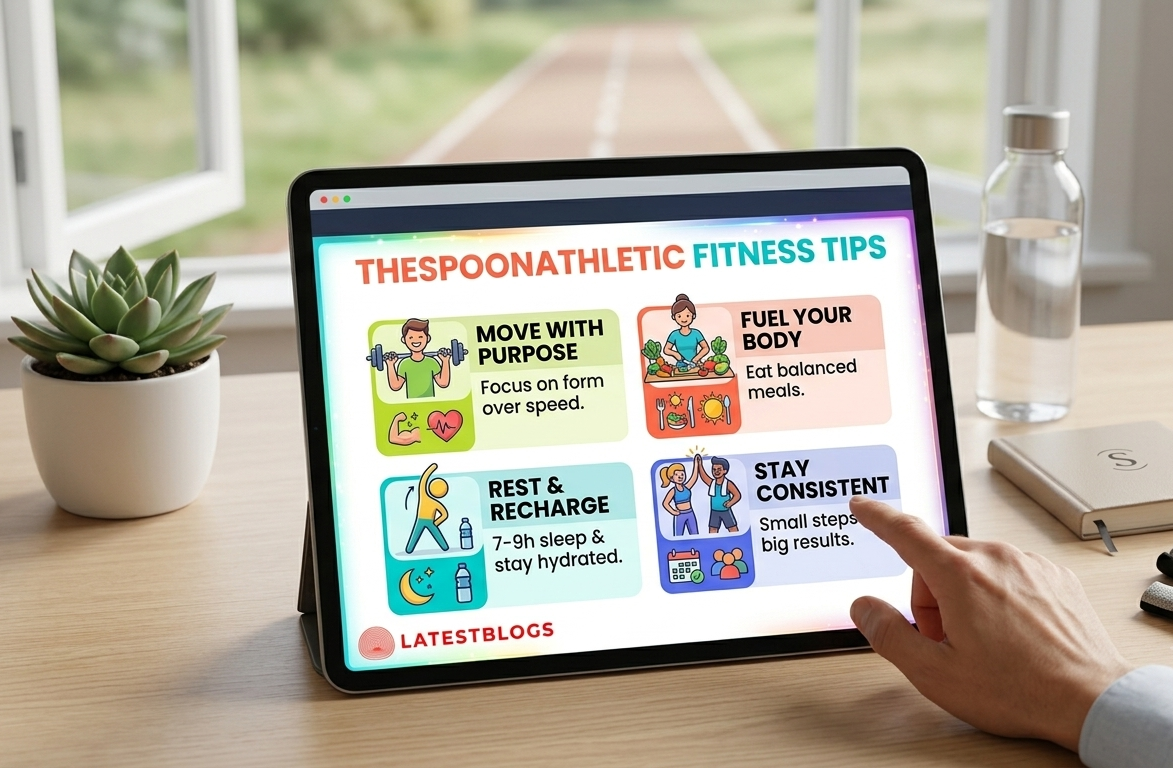
Most fitness advice online falls into one of two camps, extreme programs that burn you out in three weeks, or vague motivational fluff that never tells you what to actually do. TheSpoonAthletic fitness tips carve out a different lane, built around sustainable training principles that treat your body as one connected system rather than a collection of isolated muscles to chase separately. If you’ve been stuck cycling through fad routines that never stick, this approach is worth understanding properly, so let’s break down what it actually involves and why each piece matters.
What Is TheSpoonAthletic Approach to Fitness
At its core, this approach for Thespoonathletic Fitness Tips combines strength training, cardiovascular conditioning, and intelligent recovery into one connected system rather than treating them as separate boxes to check. The philosophy rests on three central principles, progressive overload, functional movement patterns, and strategic recovery, and all three are meant to work together rather than being applied in isolation. Skip any one of them and the whole system starts to break down, no matter how hard you’re working on the other two.
What separates this from extreme fitness programming is the underlying goal. Instead of chasing rapid transformation through restrictive diets or punishing daily workouts, the focus stays on developing athletic capability that actually carries over into everyday life, not just how you look in a mirror. That distinction matters more than it sounds. Thespoonathletic Fitness Tips & Training that only optimizes for appearance often neglects the functional strength, mobility, and cardiovascular capacity that make daily movement easier and reduce injury risk over the long run.
This method also treats beginners and experienced athletes as needing the same underlying principles, just applied at different intensities. A beginner and a seasoned lifter both benefit from progressive overload, both need recovery built into their week, and both perform better with compound, functional movements as the backbone of their training. The application changes with experience level, but the fundamental structure doesn’t need reinventing for each person, it just needs scaling. Thespoonathletic Fitness Tips are very important if you want to keep yourself fit.
Why Progressive Overload Is the Foundation of Real Progress

Progressive overload is the simple idea that your muscles only grow stronger when they’re challenged beyond what they’re already used to handling. If you lift the same weight, for the same reps, week after week, your body has no reason to adapt further, and progress naturally stalls out. This is one of the most well-established principles in exercise science, and it’s the reason so many people plateau despite showing up consistently to the gym.
The key is applying overload gradually rather than aggressively. Increasing weight, repetitions, or overall training volume by small increments, typically somewhere in the range of 2 to 5 percent at a time, tends to produce steadier, more sustainable results than trying to jump dramatically from one week to the next. Small, consistent increases give your muscles, joints, and connective tissue time to adapt alongside the added demand, which matters just as much for injury prevention as it does for building strength.
It’s worth being honest about the pace of this process too. Progressive overload isn’t something you notice day to day, it’s something that compounds over months and years of consistent application. People who follow Thespoonathletic Fitness Tips succeed long-term with this kind of training tend to prioritize steady, boring consistency over short bursts of intensity, since the body simply doesn’t adapt on a timeline that rewards impatience. Thespoonathletic Fitness Tips can transform your body and Thespoonathletic Fitness Tips can also give you inner peace and satisfaction after every session you do.
Building Your Cardio Around Heart Rate Zones
Cardiovascular training benefits enormously from structure, and heart rate zones are one of the most practical ways to add that structure without overcomplicating things. Zone 2 training, generally sitting around 60 to 70 percent of your estimated maximum heart rate, is often described as a “conversational pace,” meaning you should be able to hold a conversation without gasping for breath while doing it. This lower-intensity zone builds your aerobic base and improves fat-burning efficiency without creating the kind of systemic fatigue that interferes with your strength training. However, these Thespoonathletic Fitness Tips can increase your heart health.
A rough estimate of your maximum heart rate comes from subtracting your age from 220, though it’s worth remembering this is a general formula rather than a precise individual measurement. For a 30-year-old, that works out to an estimated max of around 190 beats per minute, putting Zone 2 somewhere in the 114 to 133 beats per minute range. The majority of your cardio work, generally around 70 to 80 percent of it, should sit in this lower-intensity zone, since it’s what most effectively builds your underlying aerobic capacity over time.
Higher-intensity work, typically in the 80 to 100 percent range of max heart rate, still has a place, particularly for improving VO2 max and anaerobic capacity through interval training. However, this kind of high-intensity interval training creates significantly more systemic stress on your body than steady-state cardio does, which is why it’s generally recommended in more limited doses, around 2 to 3 sessions a week, and never on back-to-back days. Balancing the bulk of your cardio in Zone 2 with a smaller, focused dose of high-intensity work tends to produce better overall conditioning than leaning heavily on either extreme alone. Regular Thespoonathletic Fitness Tips can make you feel better every day.
Strength Training the Smart Way with Compound Movements
Compound, multi-joint movements consistently outperform isolated exercises when your goal is functional, real-world strength rather than just targeting a single muscle in isolation. These movements recruit more muscle groups at once, burn more total energy per session, and translate more directly into the kind of strength and stability that actually helps outside the gym, whether that’s carrying groceries, climbing stairs, or picking something up off the floor without straining your back. Regular Thespoonathletic Fitness Tips can make you look better then before.
Squats sit near the top of this list, engaging the quads, glutes, and core simultaneously, while deadlifts activate the entire posterior chain and support better posture over time. Push-ups and bench press work the chest, shoulders, and triceps together in a single movement, and pull-ups and rows build the back width and thickness that balances out all that pressing work, which matters for shoulder health as much as it does for appearance. Rounding things out, lunges and step-ups add unilateral training that improves balance and helps prevent the kind of asymmetries that lead to nagging injuries, while planks and anti-rotation holds build the deep core stability that underpins almost every other athletic movement. Regular Thespoonathletic Fitness Tips can make you feel better look fresh comparatively.
Building a training week around these core movement patterns, rather than a long list of isolated exercises, tends to be more time-efficient and more effective for general athletic development. That doesn’t mean isolation work has no place, accessory exercises can still address specific weak points, but the compound lifts should form the structural backbone of your training rather than being an afterthought squeezed in around isolation work. Regular Thespoonathletic Fitness Tips can make you feel better soon after you start doing it.
Recovery and Deload Weeks Matter More Than You Think
Continuous hard training without planned breaks eventually accumulates fatigue that suppresses performance rather than improving it, even if you’re technically still showing up and putting in effort. This is where the concept of a deload week comes in, a planned period, roughly every 4 to 6 weeks, where you reduce training volume by about 40 to 50 percent while keeping intensity relatively similar. This isn’t a step backward, it’s a structured pause that allows your body to catch up on the adaptation your training has been demanding.
This process is often referred to as supercompensation, where fitness actually peaks after a period of reduced training stress rather than during the hardest training block itself. Skipping this kind of planned recovery in favor of constant, uninterrupted intensity tends to backfire over time, leading to stalled progress, elevated injury risk, and the kind of burnout that convinces people to quit training altogether, which defeats the entire long-term purpose of building sustainable habits. You would realize Thespoonathletic Fitness Tips are very important soon after you start doing it.
Recovery isn’t just about deload weeks either, sleep plays an outsized role in the process. Most adults need somewhere between 7 and 9 hours of quality sleep a night, since this is when the body releases the hormones responsible for muscle repair and overall recovery. It’s also worth learning to distinguish productive discomfort, like the normal muscle burn from a hard set, from harmful pain, like sharp or shooting sensations, since training through the wrong kind of pain is one of the most common ways people turn a minor issue into a long-term injury.
Nutrition Habits That Support Your Training
Exercise alone can’t produce optimal results without nutrition backing it up, and this doesn’t require an overly restrictive or complicated approach to work. A straightforward focus on whole foods, adequate protein, and consistent hydration tends to outperform extreme diets that are difficult to sustain past the first few weeks. Protein in particular plays a critical role here, since it directly supports the muscle repair and growth that your training is trying to stimulate in the first place.
Hydration deserves more attention than it usually gets, especially given how directly it affects both performance and recovery. Starting your day with water before reaching for coffee helps replenish fluid balance after a night without intake, and staying consistently hydrated throughout the day supports both physical performance and mental clarity. Balanced meals built around protein, carbohydrates, and healthy fats help maintain steady energy levels, which matters just as much for the quality of your workouts as the workouts themselves. Regular Thespoonathletic Fitness Tips can make you feel better.
None of this needs to turn into obsessive calorie counting or rigid meal planning to be effective. The goal is building sustainable eating habits that support your training consistently, not creating a system so restrictive that it becomes another source of burnout. Simple, repeatable choices, eating protein with most meals, prioritizing whole foods over heavily processed options, and staying consistently hydrated, tend to be far more sustainable than complicated, hard-to-follow nutrition plans.
Tracking Progress Beyond the Scale
Relying purely on scale weight to measure progress misses most of what’s actually happening in your body, and it’s one of the most common reasons people get discouraged and quit even when they’re making real progress. A more complete picture comes from tracking multiple types of metrics together, performance markers like weight lifted or running pace, body composition indicators like how your clothes fit or progress photos, recovery signals like resting heart rate and sleep quality, and simple consistency metrics like how many workouts you actually completed each week. Regular Thespoonathletic Fitness Tips are the discussion of most of the gathering now a days.
Tracking at least a few of these metrics consistently, rather than fixating on any single number, gives a far more accurate sense of whether your training is actually working. Taking measurements under consistent conditions, similar time of day, similar clothing, similar circumstances, also helps reduce the noise that makes week-to-week comparisons unreliable and frustrating.
The bigger point here is shifting your mindset away from obsessing over daily fluctuations and toward recognizing progress across multiple dimensions over time. Someone whose scale weight hasn’t moved much in a month might still be getting noticeably stronger, recovering faster, and sleeping better, all of which are real, meaningful markers of progress that a single number on a scale simply can’t capture.
Building Sustainable Long Term Habits
Success with this kind of training approach ultimately comes down to patience, consistency, and training in a way that respects your body’s actual recovery capacity, rather than fighting against it. Rather than trying to overhaul every part of your routine at once, it tends to work better to choose 2 or 3 principles to implement immediately, whether that’s adding a deload week, prioritizing compound lifts, or simply drinking more water in the morning, and building from there once those habits feel automatic. TheSpoonAthletic Fitness Tips is the mandatory thing to add to your life.
Athletic development genuinely unfolds over months and years rather than days or weeks, and internalizing that timeline early tends to prevent a lot of the frustration that causes people to abandon good programs prematurely. The people who stick with training long-term consistently prioritize sustainability over shortcuts and treat recovery with the same seriousness as the training itself, rather than viewing rest as something to feel guilty about. Regular Thespoonathletic Fitness Tips can change your whole life.
Small, boring, repeatable actions compound into meaningful results far more reliably than any short-term intensity spike ever will. That’s really the throughline across every principle covered here, progressive overload, structured cardio, compound strength work, planned recovery, consistent nutrition, and honest progress tracking, all pointing toward the same underlying idea, that steady, sustainable effort beats extreme effort applied inconsistently, every single time. TheSpoonAthletic Fitness Tips is talk of the town.
Frequently Asked Questions
What is the core philosophy behind these Thespoonathletic Fitness Tips? The approach combines strength training, cardiovascular conditioning, and structured recovery into one connected system, built around progressive overload, functional movement, and sustainable habits rather than extreme, short-term programs.
How often should I take a deload week? A commonly recommended pattern is roughly every 4 to 6 weeks, reducing training volume by about 40 to 50 percent while keeping intensity relatively similar, allowing your body to recover and adapt.
What heart rate zone should most of my cardio be in? Most cardio work, around 70 to 80 percent of it, is generally recommended in Zone 2, roughly 60 to 70 percent of your estimated maximum heart rate, with higher-intensity intervals used more sparingly.
Why are compound movements emphasized over isolation exercises? Compound, multi-joint movements like squats, deadlifts, and pull-ups engage more muscle groups at once, burn more energy per session, and build strength that translates more directly into everyday function.
How much should I increase my Thespoonathletic Fitness Tips load each week? Small increments, typically around 2 to 5 percent increases in weight, repetitions, or overall volume, tend to produce more sustainable progress than large, aggressive jumps.
Is scale weight the best way to track fitness progress? No, tracking multiple metrics together, including performance markers, body composition, recovery indicators, and workout consistency, gives a far more accurate and motivating picture than scale weight alone.
You May Also Read: Zuhio Keyword Count Checker

