


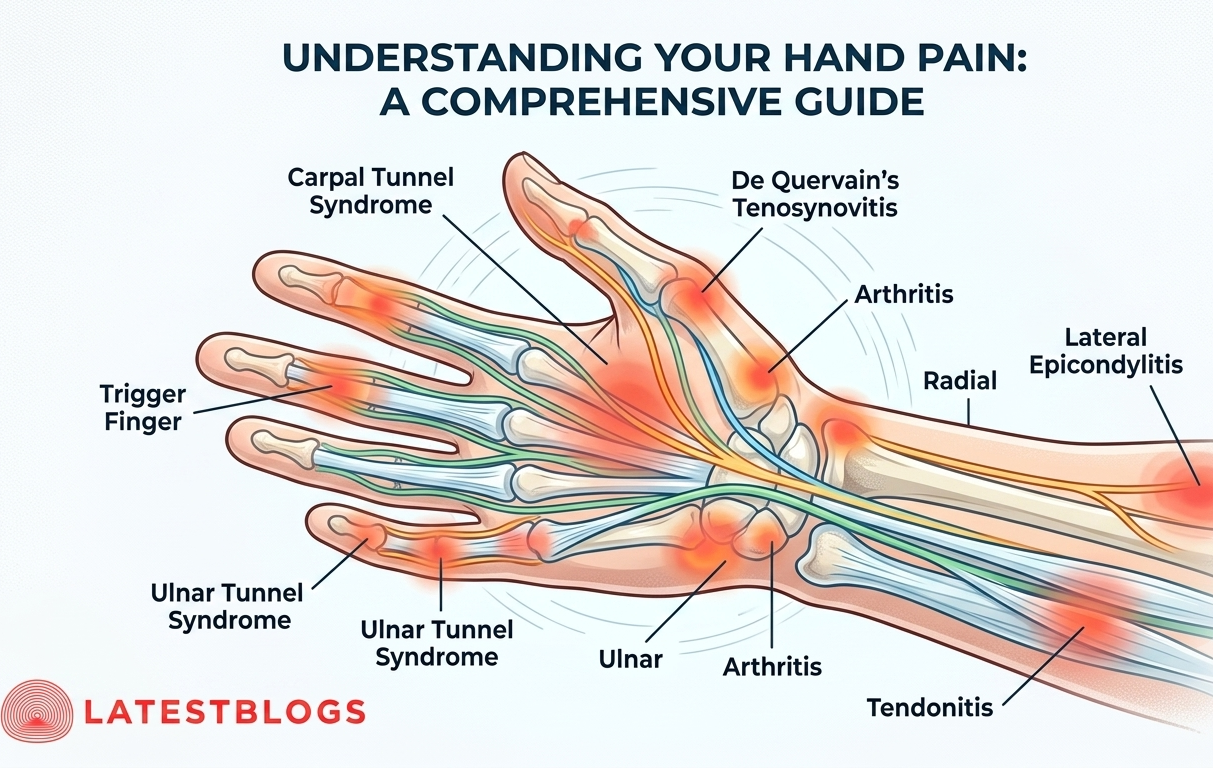
If you’ve ever searched for a hand pain diagram, you already know how frustrating it is to have a specific, nagging pain but no idea what it actually means. The hand is one of the most anatomically complex parts of the body, packed with 27 bones, dozens of tendons, and several major nerves all working through a tiny amount of space, which is exactly why pain location matters so much when it comes to figuring out what’s actually going on. This guide walks through the hand’s basic anatomy, what pain in specific locations usually points to, and when it’s time to stop guessing and see a professional.
Understanding The Basic Anatomy Behind Hand Pain
Before any hand pain diagram makes sense, it helps to understand what’s actually packed into your hand and wrist. The hand contains 27 bones total, eight small carpal bones forming the wrist, five metacarpal bones making up the palm, and fourteen phalanges forming the fingers and thumb. These bones are held together by an intricate network of ligaments, while tendons connect muscles in the forearm to the bones in the hand, allowing you to bend and straighten your fingers with the kind of precision needed for everything from typing to gripping a coffee cup. Hand pain diagram represents many aspects in details if you study hand pain diagram in details.
Three major nerves run through the hand and wrist, and each one is responsible for sensation and movement in a specific, predictable area, which is exactly why the location of nerve-related pain is so diagnostically useful. The median nerve travels through the carpal tunnel and supplies sensation to the thumb, index finger, middle finger, and half of the ring finger. The ulnar nerve runs along the pinky side of the hand and wrist, controlling sensation in the pinky and the other half of the ring finger, while the radial nerve covers sensation on the back of the hand near the thumb. When any one of these nerves gets compressed or irritated, the resulting pain, numbness, or tingling shows up in a fairly consistent, mappable pattern rather than randomly across the whole hand.
The tendons deserve just as much attention as the nerves, since a huge share of hand pain conditions are actually tendon problems rather than nerve or joint issues. Flexor tendons run along the palm side of the hand allowing you to curl your fingers, while extensor tendons run along the back of the hand allowing you to straighten them. These tendons pass through small tunnels called sheaths, and irritation or swelling within those sheaths is behind some of the most common hand pain complaints people search for, including trigger finger and De Quervain’s tenosynovitis, both of which are essentially tendons getting irritated as they try to glide through an inflamed, narrowed space.
What Pain On The Thumb Side Of Your Wrist Usually Means
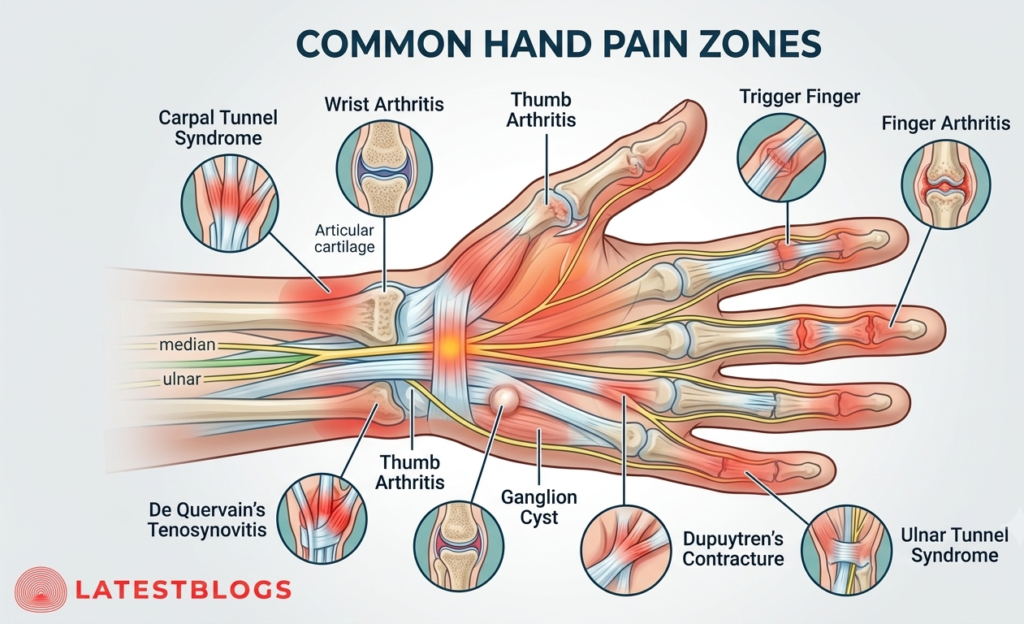
Pain specifically at the base of the thumb, right where it meets the wrist, is one of the most commonly searched hand pain patterns, and it typically points to one of two conditions depending on your age and how the pain behaves. De Quervain’s tenosynovitis involves irritation of the tendons that run along the thumb side of the wrist, and it classically causes pain when you grip something, make a fist, or twist your wrist, sometimes described as a sharp catch right at the base of the thumb. Hand pain diagram represents many aspects in details if you study hand pain diagram in details. This condition is particularly common among new parents, since the repetitive motion of lifting a baby with your thumbs extended puts direct, repeated strain on exactly this tendon pathway.
Basal joint arthritis, sometimes called thumb CMC arthritis, is the other major cause of thumb-base pain, and it tends to show up differently than De Quervain’s in a few key ways. Rather than a sharp catching sensation with specific movements, basal joint arthritis usually presents as a deeper, achier pain that worsens with pinching activities, like turning a key or opening a jar, and it tends to develop gradually over months or years rather than appearing suddenly. This condition becomes more common with age and is one of the more frequent sources of hand pain in people over 50, particularly affecting women more often than men.
Distinguishing between these two conditions matters because the treatment approaches differ meaningfully. De Quervain’s often responds well to activity modification, splinting the thumb in a way that reduces tendon strain, and anti-inflammatory approaches, while basal joint arthritis, being a degenerative joint condition rather than an inflammatory tendon issue, sometimes requires different splint designs and, in more advanced cases, different treatment discussions entirely. This is exactly the kind of distinction where a hand pain diagram helps orient you toward the right search terms, but an actual clinical exam is what confirms which condition you’re dealing with. Hand pain diagram represents many aspects in details if you study hand pain diagram in details.
What Pain In The Palm And Fingers Typically Indicates
Pain and numbness affecting the thumb, index finger, middle finger, and part of the ring finger, especially if it’s worse at night or after activities like driving or holding a phone, is the classic pattern associated with carpal tunnel syndrome. This condition happens when the median nerve gets compressed as it passes through the carpal tunnel, a narrow passageway on the palm side of the wrist, and it’s one of the most common nerve compression conditions affecting the upper body. The specific finger involvement pattern, notably sparing the pinky, is actually one of the most useful diagnostic clues, since ulnar nerve issues would affect the pinky instead.
Trigger finger presents quite differently and is usually easy to distinguish once you know what to look for. Rather than numbness or tingling, trigger finger causes a finger or thumb to catch, lock, or click when you try to bend or straighten it, sometimes with a noticeable popping sensation as the tendon releases from wherever it caught inside its narrowed sheath. There’s often a tender, palpable nodule at the base of the affected finger on the palm side, and the condition tends to be worse first thing in the morning, gradually improving somewhat as you use your hand throughout the day. Hand pain diagram represents many aspects in details if you study hand pain diagram in details.
Pain localized to a single knuckle joint, particularly if it’s accompanied by swelling, stiffness, or a small firm lump near a joint, often points toward either osteoarthritis affecting that specific joint or, less commonly, a ganglion cyst, a fluid-filled sac that can develop along tendons or joints, most frequently on the back of the wrist but occasionally on the finger joints as well. Ganglion cysts are usually painless or mildly uncomfortable and often visibly noticeable as a small bump, which makes them fairly distinguishable from arthritis-related joint pain once you know to look for that visible swelling as a distinguishing feature.
What Pain On The Pinky Side Of Your Hand Usually Suggests
Pain, numbness, or tingling affecting specifically the pinky finger and half of the ring finger points toward the ulnar nerve rather than the median nerve, and this pattern usually indicates a condition called cubital tunnel syndrome or, less commonly, Guyon’s canal syndrome. Cubital tunnel syndrome involves compression of the ulnar nerve at the elbow, the same nerve that produces that unmistakable “funny bone” sensation when you bump your elbow, and prolonged elbow bending, like sleeping with your arm curled under your pillow, is a common aggravating factor.
Guyon’s canal syndrome, by contrast, involves ulnar nerve compression specifically at the wrist rather than the elbow, and it’s often associated with repetitive pressure on the base of the palm, something seen frequently in cyclists who grip handlebars for extended periods, or in people whose jobs involve repeated pressure against that specific part of the hand. Both conditions produce similar symptoms in terms of which fingers are affected, but the location of the compression, and therefore the treatment approach, differs, which is why simply knowing “my pinky and ring finger are numb” isn’t quite enough information on its own to know which specific nerve entrapment is involved. Hand pain diagram represents many aspects in details if you study hand pain diagram in details.
Pain along the outer edge of the hand, particularly if it worsens with gripping or specific wrist movements, can also stem from tendon issues affecting the extensor carpi ulnaris tendon, which runs along this same pinky-side pathway on the back of the wrist. This is a less commonly discussed condition compared to carpal tunnel or De Quervain’s, but it’s a real source of ulnar-sided wrist pain, particularly in athletes involved in racquet sports or golf, where repetitive wrist rotation puts specific strain on this tendon pathway.
When A Hand Pain Diagram Isn’t Enough And You Need A Professional
While understanding general pain location patterns is genuinely useful for narrowing down possibilities and having a more informed conversation with a doctor, it’s important to be honest about the limits of self-diagnosis based on symptom location alone. Many hand conditions share overlapping symptoms, several conditions can coexist simultaneously, and conditions like carpal tunnel syndrome can sometimes cause more diffuse symptoms than the classic textbook pattern, particularly in more advanced or long-standing cases. A hand pain diagram is a starting point for understanding your body, not a replacement for an actual clinical evaluation. Hand pain diagram represents many aspects in details if you study hand pain diagram in details.
Certain warning signs should prompt a faster visit to a healthcare provider rather than continued research. Sudden, severe pain following an injury, visible deformity, an inability to move a finger or the wrist normally, significant swelling that develops rapidly, or numbness that’s constant rather than intermittent are all signals that something more urgent than typical overuse-related tendon or nerve irritation may be occurring, potentially including fractures, dislocations, or more serious nerve injuries that need prompt attention rather than home management.
For persistent but non-emergency hand pain, a hand specialist, either an orthopedic surgeon specializing in hand and upper extremity conditions or a physical or occupational therapist with hand therapy training, can perform specific clinical tests, like Tinel’s sign for nerve compression or the Finkelstein test for De Quervain’s tenosynovitis, that go well beyond what any diagram or symptom checklist can offer. These tests, combined with imaging when necessary, are what actually confirm a diagnosis, and getting an accurate diagnosis early tends to lead to simpler, more effective treatment than waiting until a condition has progressed significantly. Hand pain diagram represents many aspects in details if you study hand pain diagram in details.
Frequently Asked Questions
What does pain at the base of my thumb usually mean?
It commonly indicates either De Quervain’s tenosynovitis, involving irritated tendons, or basal joint arthritis, a degenerative condition affecting the joint where the thumb meets the wrist, with treatment differing depending on which one is present.
Why does carpal tunnel syndrome specifically affect certain fingers?
Carpal tunnel syndrome compresses the median nerve, which supplies sensation to the thumb, index, middle, and half of the ring finger, notably sparing the pinky, which helps distinguish it from ulnar nerve conditions.
What’s the difference between trigger finger and arthritis pain?
Trigger finger causes a catching or locking sensation when bending or straightening a finger, often with a palpable nodule at the base, while arthritis pain tends to be a more constant ache localized to a specific joint, often with associated stiffness.
Why are my pinky and ring finger numb?
Numbness in these two fingers typically points to ulnar nerve involvement, which can occur at the elbow through cubital tunnel syndrome or at the wrist through Guyon’s canal syndrome.
Can hand pain be caused by more than one condition at once?
Yes, it’s fairly common for conditions like carpal tunnel syndrome and trigger finger, or arthritis and tendon irritation, to occur simultaneously, which is part of why self-diagnosis based on location alone has real limits.
When should I see a doctor instead of just monitoring hand pain at home?
Seek prompt medical attention for sudden severe pain after an injury, visible deformity, inability to move a finger normally, rapid swelling, or constant numbness, since these can indicate fractures, dislocations, or more serious nerve involvement.
You May Also Read: Obernaft

